

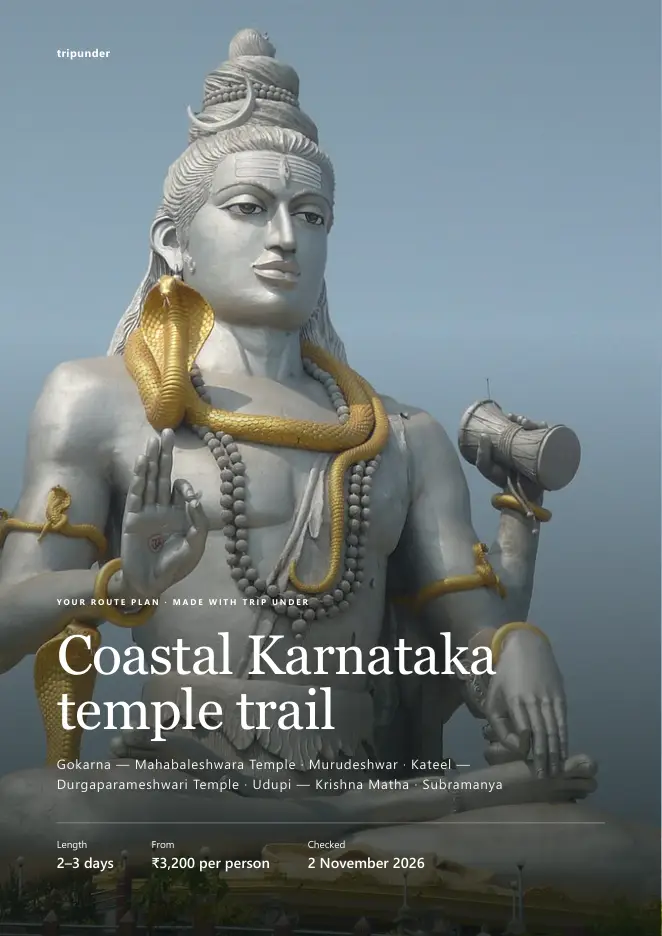
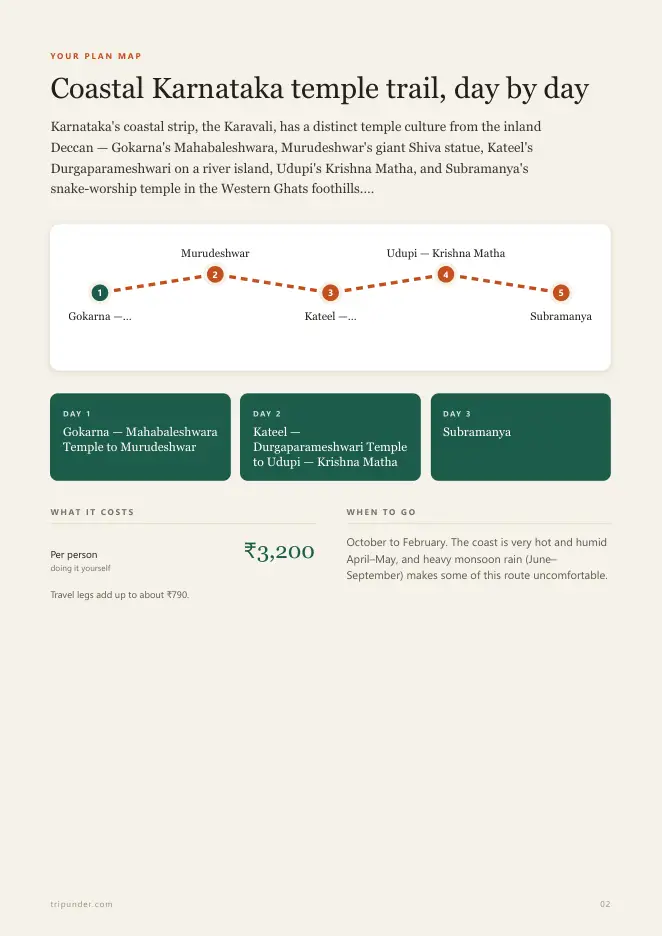
Karnataka's coastal strip, the Karavali, has a distinct temple culture from the inland Deccan — Gokarna's Mahabaleshwara, Murudeshwar's giant Shiva statue, Kateel's Durgaparameshwari on a river island, Udupi's Krishna Matha, and Subramanya's snake-worship temple in the Western Ghats foothills. Together they trace the length of Karnataka's coast and its distinct Konkan-Tulu religious traditions.
Step 2 of 6Next: Route↓Coastal Karnataka temple trail, planned for you
Day-by-day timings, the route, what each part costs, where to sleep and eat, and a checklist. One PDF that works offline: print it, or send it to everyone going.
- Day 1 Gokarna — Mahabaleshwara Temple to Murudeshwar
- TravelGokarna — Mahabaleshwara Temple₹400
- TravelMurudeshwar₹100
- Day 2 Kateel — Durgaparameshwari Temple to Udupi — Krishna Matha
- Day 3 Subramanya
₹49 once, 6 pages. Secure payment by Razorpay, instant download. Already bought? Get your download


The route, stop by stop
The whole route first. Tap any stop and the map zooms to just that place.
Route
Stops
Gokarna — Mahabaleshwara Temple → Murudeshwar → Kateel — Durgaparameshwari Temple → Udupi — Krishna Matha → Subramanya · Directions in Google Maps ↗
- 1Start — train or bus from Goa or Bengaluru Map ↗
- 275 km south, bus or train Map ↗
- 3100 km further, on a Nethravathi river island Map ↗
- 425 km from Kateel Map ↗
- 575 km inland, in the Western Ghats foothills Map ↗
Travel legs add up to about ₹790 per person.
Step 3 of 6Next: Cost↓What it costs
Ballpark ranges, not live quotes. Prices last updated 6 October 2026. Prices move with season and demand, so check live fares before you book. Spot a wrong price? Tell us and we fix it.
A do-it-yourself budget: trains and buses, simple lodges and temple meals. Paid darshan and donations are extra.
What to book ahead
Where to stay and eat
Stay
Udupi is the most practical central base, with Gokarna or Murudeshwar as alternative anchors depending on which end you start from.
Food
This coast has a completely different food culture from inland Karnataka — Udupi's own vegetarian tradition, and excellent coastal seafood elsewhere along the route.
Photos
Questions people ask
How many days do you need for Coastal Karnataka temple trail?
2–3 days, starting from Mangaluru or Gokarna.
What is the best time for Coastal Karnataka temple trail?
October to February. The coast is very hot and humid April–May, and heavy monsoon rain (June–September) makes some of this route uncomfortable.
How much does Coastal Karnataka temple trail cost?
From about ₹3,200 per person doing it yourself, with the travel legs adding up to roughly ₹790.
What needs to be booked in advance?
Nothing requires advance booking: All five are straightforward day visits with standard darshan. Udupi hotel: The most convenient central base for this route, with the widest choice of stays. Coastal trains: The Konkan Railway links most of these towns directly — check timings, as some routes have limited daily services.
Where do pilgrims stay?
Udupi is the most practical central base, with Gokarna or Murudeshwar as alternative anchors depending on which end you start from.
What about food?
This coast has a completely different food culture from inland Karnataka — Udupi's own vegetarian tradition, and excellent coastal seafood elsewhere along the route.
More sacred places and routes
 Sringeri, Horanadu & Kollur2–3 days · from Chikmagalur or UdupiFrom ₹3,500
 Dharmasthala & Kukke Subramanya2 days · 1 night · from BengaluruFrom ₹1,800
 Badami, Pattadakal & Aihole2 days · 1 night · from Vijayapura or HampiFrom ₹2,800
Underrated places near by
 GokarnaFive beaches strung along a cliff walk, a working temple town at one end, and rooms at half what…From ₹800/day
 MurudeshwarA 37-metre Shiva statue looks out to sea from a rocky headland, with a working beach town around…From ₹900/day
 Jog FallsThe Sharavathi river falls 253 metres in four separate streams — Raja, Roarer, Rocket and Rani —…From ₹1,000/day
Costs are indicative ballparks for doing it yourself and change with season and demand. Always check live fares, rates and opening rules before you book. Trip Under is not a travel agency: we don't sell packages or bookings, we take no commission, and we link to maps and official sites, never to booking sites. Every guide is free; our only paid products are optional downloadable trip plans and itineraries. Photographs come from Wikimedia Commons under free licences; see credits.
By Gokul · Updated 6 October 2026 · Photo: Thamarai Krishnamoorthi · CC BY-SA 3.0 · source · Photo: Nvvchar · CC BY-SA 3.0 · source · Photo: Ashok Prabhakaran from Chennai, India · CC BY-SA 2.0 · source · Photo: Pragathi. BH · CC BY-SA 4.0 · source


